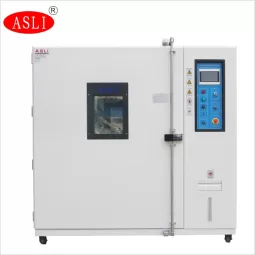




Thermal Cyling Temperature Shock Testing Two In One Chamber TH-225 ,TH-408 ,TH-150
Are you looking for a chamber that not only performs fast temperature change testing, but can also conduct temperature shock testing?
In many semiconductor and electronics reliability laboratories, engineers often require both thermal cycling tests and thermal shock tests to evaluate the durability of components under extreme environmental conditions. Traditionally, these tests require two different testing systems, which means higher equipment costs, larger laboratory space requirements, and more complicated testing procedures.
Today, a two-in-one environmental test chamber provides a more efficient solution.
Why Do Engineers Need Both Thermal Cycling And Thermal Shock Testing?
Thermal cycling testing and thermal shock testing are both widely used methods to evaluate the reliability of electronic components and semiconductor devices.
Thermal Cycling Testing simulates gradual temperature transitions between high and low temperature conditions to evaluate long-term reliability.
Thermal Shock Testing exposes products to rapid and extreme temperature changes to identify potential structural weaknesses caused by sudden thermal stress.
Both tests are critical for industries such as:
Semiconductor manufacturing
Integrated circuit reliability verification
Automotive electronics testing
Aerospace electronic components
Advanced materials research
Standards such as IEC 60749-4-2002, AEC-Q100, and JEDEC JESD22-A104 require these types of environmental reliability tests for semiconductor devices and automotive-grade electronic components.
The Challenge With Traditional Testing Equipment
Most laboratories traditionally use separate systems for different types of environmental tests:
Rapid temperature change chamber
Thermal shock chamber
Operating two separate chambers can lead to several challenges:
Higher equipment investment
Increased laboratory space requirements
Complex test scheduling
Higher maintenance costs
For laboratories performing frequent reliability testing, this setup can significantly reduce efficiency.
A More Efficient Solution: Two-In-One Environmental Test Chamber
A Thermal Cycling Temperature Shock Testing Two-In-One Chamber integrates multiple environmental testing capabilities into a single system.
This advanced chamber can perform:
Rapid temperature change testing
Thermal cycling testing
Thermal shock testing
By combining these testing functions, laboratories can perform multiple environmental stress tests using one piece of equipment.
This design significantly improves laboratory efficiency while reducing equipment investment and operational complexity.
Advanced Environmental Simulation Capabilities
Modern environmental test chambers are designed to simulate extreme testing conditions with high precision.
In addition to rapid temperature transitions, advanced chambers can also support humidity control under certain high-temperature or linear temperature change conditions. This allows engineers to conduct more comprehensive environmental simulations for sensitive electronic components and materials.
With precise temperature control and stable environmental performance, these chambers are suitable for demanding reliability verification tests required by the semiconductor and automotive industries.
Applications Across Multiple High-Tech Industries
Two-in-one thermal cycling and temperature shock chambers are widely used in industries that require strict reliability testing.
Typical applications include:
Semiconductor and IC reliability testing
Automotive electronics validation
Electronic component stress testing
PCB and module reliability evaluation
Aerospace electronic systems testing
Research laboratories and quality inspection centers
As electronic products become smaller, faster, and more complex, environmental reliability testing plays an increasingly important role in ensuring long-term product stability.
Improve Testing Efficiency With Integrated Environmental Testing
A chamber capable of performing thermal cycling, rapid temperature change, and thermal shock testing in one system offers significant advantages for modern laboratories.
By combining multiple environmental testing capabilities into a single chamber, manufacturers and research institutions can improve testing efficiency, reduce equipment costs, and perform comprehensive reliability evaluations more effectively.
For companies working in semiconductor manufacturing, automotive electronics, and advanced electronics development, integrated environmental testing systems provide a practical and efficient solution for meeting strict reliability standards.